
Professional proofreading is the final layer of refinement before your document goes live. But what actually happens when you hand your work to a proofreader? And how do you know you're getting real value for your investment?
If you're thinking about hiring a professional proofreader, you should know exactly what to expect from the process, what gets reviewed, and how to spot a service that actually delivers quality work.
Related: What Does a Professional Proofreader Check
Related: How to Prepare Manuscripts for Professional Typesetting
Understanding the Scope of Professional Proofreading
Professional proofreading focuses on line-level corrections. Your proofreader isn't rewriting sentences or restructuring arguments. They're fixing what's already there.
Expect them to catch:
- Grammar and syntax errors
- Spelling mistakes
- Punctuation problems
- Capitalization inconsistencies
- Usage issues (like "its" vs. "it's")
A good proofreader also watches for consistency in style throughout your document. If you use "toward" on page one and "towards" on page fifteen, they'll flag it and make sure you're uniform. This matters because it makes your work look polished and professional.
Beyond mechanics, professional proofreading improves overall readability and flow. Your proofreader reads like your audience will read, spotting sentences that feel clunky or paragraphs that don't transition smoothly. Xcel Graphic Services handles this as part of their proofreading process, ensuring your document doesn't just correct errors but reads well.
The Submission and Review Process
When you hire a professional proofreader, you'll need to understand the workflow. Most services ask you to submit your document in a standard format, like Word or PDF.
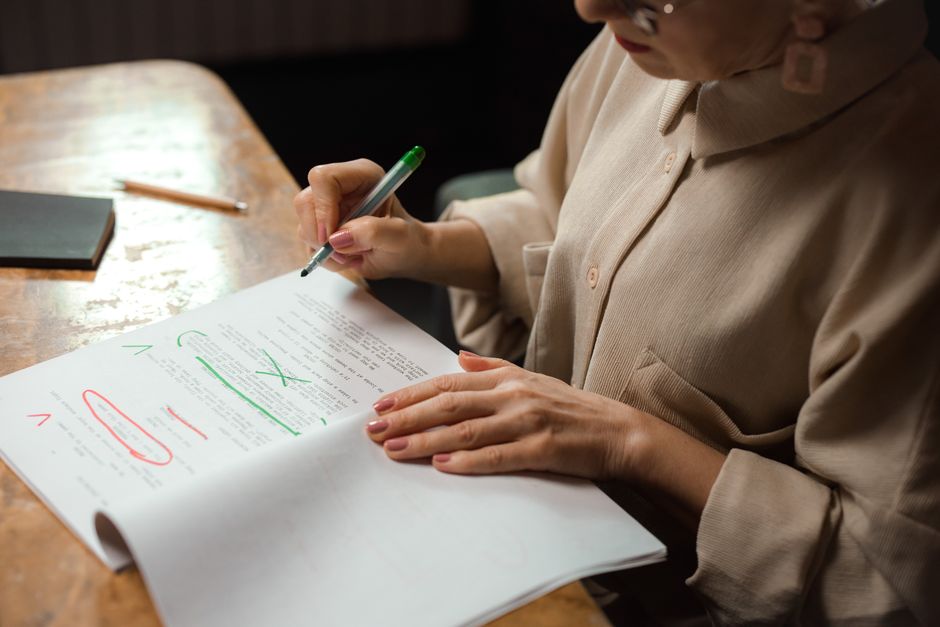
Your proofreader will review the entire document and mark changes. Some use track changes in Word so you can accept or reject each edit. Others provide a marked-up version with comments explaining their fixes. Make sure you understand the submission format and delivery method before you commit.
Timeline matters too. Ask how long the turnaround will be. Professional services usually give you a timeline based on document length and their current workload. Proofreading isn't instant, and reputable providers will give you realistic expectations.
Why Editor Qualifications Matter
Not all proofreaders are equal. The person reviewing your work should have real expertise, not just basic grammar knowledge.
Look for proofreaders who:
- Have formal training in editing or publishing
- Have experience with your specific field or industry
- Can provide samples of their work
- Understand the style guide you're using (Chicago Manual of Style, APA, AP, etc.)
If you're publishing academic work, technical documentation, or specialized content, field-specific expertise matters. A proofreader with experience in your niche understands terminology, conventions, and what readers in your space expect.
Always ask about the qualifications of the person who will review your work. If a service can't tell you who's editing your document or what their background is, that's a red flag.
Sample Editing Helps You Choose
Before you commit to a service, request sample editing. Send a few pages of your work and ask the proofreader to show you how they'd handle it.
This gives you a chance to see their style, their level of detail, and whether they understand what you need. You'll also get a feel for how they communicate feedback. Do their comments make sense? Are they thorough without being nitpicky? Do they respect your voice while fixing errors?
Sample work is the best way to evaluate whether a proofreader's approach matches your expectations. It's worth asking for before you move forward with a full project.
When Professional Proofreading Works Best
Timing matters. Professional proofreading is most effective after you've completed substantial writing and revision. Don't hire a proofreader to fix a rough draft. Do your own editing first. Rewrite sections that need work. Reorganize paragraphs that don't flow.
Then bring in a professional. They'll catch what you missed after you've done the heavy lifting.
This is why professional proofreading services work best as the final step before publication. You're not asking a proofreader to solve structural problems. You're asking them to polish a document that's already solid.
Comprehensive Coverage Means Everything Gets Reviewed
You should expect a thorough review. That means your proofreader isn't just spot-checking. They're reading every sentence, every paragraph, every page.
Good services address grammar, punctuation, spelling, syntax, and usage all at once. They don't just fix obvious typos. They catch subtle errors that most people miss on their own read-through.
This comprehensive approach is why professional proofreading actually saves you time and money. You're not going through multiple rounds of fixes because everything gets addressed in one careful pass.
How to Evaluate Professional Proofreading Services
When you're comparing services, focus on these factors:
- Editor credentials: Training, experience, and field expertise
- Sample work: Always request and review samples before committing
- Demonstrated quality: Look for detailed, thoughtful feedback in samples
- Clear communication: How do they explain their edits? Are they responsive to questions?
- Process transparency: Can they explain their workflow and timeline clearly?
Don't just go with the cheapest option or the fastest turnaround. Professional proofreading is an investment in making your work look credible and polished. The quality of that investment depends entirely on who's doing the work and how carefully they approach it.
What Happens After Proofreading
Once you receive your proofread document, you'll review the edits and decide what to accept. You're always in control. Your proofreader is offering expertise, not making final decisions about your work.
Read through the marked-up version carefully. Understand why each change was suggested. If something doesn't feel right, you can reject it. But most professional recommendations are worth accepting because they're based on experience and careful reading.
For publishing projects that include layout, design, or format conversion, proofreading is often just one part of a larger production workflow. Services like Xcel Graphic Services integrate proofreading with typesetting, indexing, and eBook conversion so your entire publishing process flows smoothly.
Red Flags to Watch For
Be cautious if a service:
- Won't show you samples before you hire them
- Can't tell you who will be reviewing your work
- Offers turnaround times that seem unrealistically fast
- Makes changes without explaining why
- Has no way to contact them with questions
- Doesn't use track changes or any clear marking system
Professional proofreading should feel collaborative and transparent. If a service feels opaque or rushed, look elsewhere.
People Also Ask
Is professional proofreading worth the cost?
Yes, if you're publishing work that represents your expertise or your brand. Typos and grammar errors make you look careless, even if the rest of your work is excellent. Professional proofreading ensures your final document is polished and error-free. It's especially valuable for academic papers, business documents, and published books where credibility matters.
How is proofreading different from copyediting?
Proofreading is narrower in scope. It catches grammar, spelling, punctuation, and style errors. Copyediting goes deeper, improving clarity, tone, flow, and sometimes reorganizing content. Both services improve your work, but they operate at different levels. Proofreading is typically the final step before publication.
Should I use proofreading software instead of hiring a person?
Software is helpful for catching obvious errors, but it misses a lot. Automated tools can't understand context or catch subtle grammar issues. They also can't evaluate whether your writing flows well or whether your style is consistent throughout. Professional proofreaders bring human judgment and expertise that software simply can't replicate. For important documents, hiring a real person is worth the investment.
Can I request a proofreader who specializes in my field?
Absolutely. If you're working in a specialized area like law, medicine, academia, or technical writing, ask the service whether they have someone with expertise in your field. Field-specific knowledge means your proofreader will understand terminology and conventions that matter to your audience. Don't settle for a general proofreader if your content requires specialized attention.
Frequently Asked Questions
People Also AskIs professional proofreading worth the cost?
Yes, if you're publishing work that represents your expertise or your brand. Typos and grammar errors make you look careless, even if the rest of your work is excellent. Professional proofreading ensures your final document is polished and error-free. It's especially valuable for academic papers, business documents, and published books where credibility matters.
How is proofreading different from copyediting?
Proofreading is narrower in scope. It catches grammar, spelling, punctuation, and style errors. Copyediting goes deeper, improving clarity, tone, flow, and sometimes reorganizing content. Both services improve your work, but they operate at different levels. Proofreading is typically the final step before publication.
Should I use proofreading software instead of hiring a person?
Software is helpful for catching obvious errors, but it misses a lot. Automated tools can't understand context or catch subtle grammar issues. They also can't evaluate whether your writing flows well or whether your style is consistent throughout. Professional proofreaders bring human judgment and expertise that software simply can't replicate. For important documents, hiring a real person is worth the investment.
Can I request a proofreader who specializes in my field?
Absolutely. If you're working in a specialized area like law, medicine, academia, or technical writing, ask the service whether they have someone with expertise in your field. Field-specific knowledge means your proofreader will understand terminology and conventions that matter to your audience. Don't settle for a general proofreader if your content requires specialized attention.